
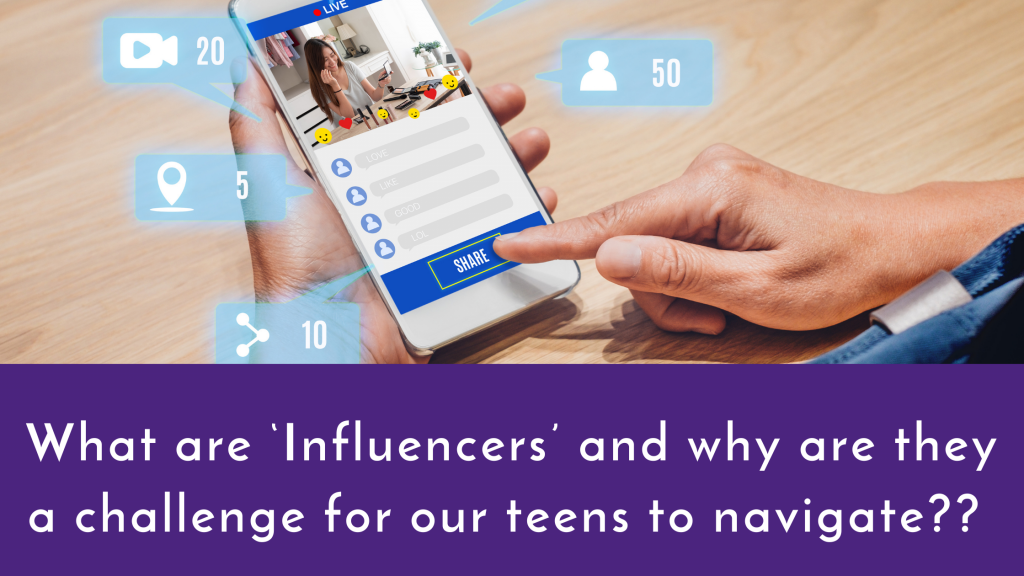
In my book ‘Reopening the Slammed Door’, I talk about the term ‘influencer’ and my thoughts around the celebrity status they often gain in our teenager’s worlds.
By ‘influencer’ I mean any person who is using their position in the digital world to elevate their thoughts about certain subjects and products, to ‘influence’ others to buy, play or engage with them. This status often amounts to a huge number of followers on social media, which means that when they mention or do something, lots of people see what they are doing, saying, or buying.
Now for us, pre-mobile phone/internet generation, this term is a completely new one, a bit like ‘selfie’ which, did you know, is now included in the Oxford English Dictionary?
This group can vary in age but in the main they comprise of our younger generation. Now many of these youngsters may seem harmless enough, and some may even be using their platforms for good and meaningful causes which appeal to our teenagers emerging sense of the world and what are important causes for them to highlight and feel passionate about. This is where we can see the digital world being used for good.
The ones who concern me however, are the ones which are promoting how our young people look to the world, how they need to be seen, including the right clothes and outfits, or those playing games and involved in what appears to be harmless dialogue but have young people staying up until all hours of the day and night waiting for their next live streams.
These people do not have stories with messages or morals. They do not have a beginning, a middle or an end. They are just a mindless stream of camaraderie which distracts our teens and, in some situations can give them a false sense of life and what can be achieved. They get paid to promote products which they have not used themselves, in an unregulated market to vulnerable and easily influenced young people.
So, what on earth can we do to help our teens understand the risks as well of the benefits of interacting with these people…because we all know we cannot and should not ‘tell’ a teenager what to do!
Truth is, we can’t stop them, as long as our teens are paying attention to these groups, they will be able to make a living out of whatever they are doing. In the main they can be entertaining, and as long as it stays in that zone then we can feel (relatively) reassured.
BUT
We are becoming more aware that endless streaming and watching countless vlogs and videos can take over our children’s lives to the degree that they struggle to regulate their watching patterns and behaviour, and even start to withdraw from ‘real life’.
Images and filters can also have a pervasive influence on our pre-teens and teens feelings about themselves and the way they look, which we know has a significant impact on their self-confidence and self-esteem.
Explaining how these people make their money and their unrealistic, and sometimes risk-taking behaviours may well fall on deaf ears (it does in our house), but we can still keep repeating the message and attempt to obtain some kind of balance in their lives while they go on the journey of working out who is worth listening and paying attention to. I relate a lot of this discussion around the programmes we used to watch as teens, with drama and story lines. Remember Grange Hill and Byker Grove? These programmes introduced teen issues, sometimes challenging ones, but in the form of stories with a beginning, middle and end. This is because they were made by adults, with a rational brain who wanted to educate as well as entertain. In this way, these programmes actually help with much more value than the endless vocalisations of a small group of youngsters professing to be ‘living the dream’.
I write this as a parent, as well as a professional, whose teen was stung financially by these groups. I kicked myself for not being more in tune with what he was doing, he didn’t even realise it himself, and was devastated when he realised the consequences of multiple subscriptions to multiple streamers had meant.
It showed me the need, not to police their every move, but to continually have conversations with our pre-teens and teenagers about these people who have immersed their world. Showing an interest rather than coming in at a critical level is more likely to lead to a more open sharing of information, even if you have no idea what they are talking about.
Our teens still need us to be aware of what is going on in their world, that fine balance of information gathering and respecting their privacy. Their brains not being fully mature, and their impulsive, ‘black and white’ thinking means that conversations need to be had at times when they are at their most receptive. Remember the idea of ‘planting the seed’. They may kick back, they may resist but what you say does go in somewhere, on some level. It is a lot more effort to stay in touch with what our teens are doing, but it can be massively beneficial for us and them, and ensures that they know that if they get into difficult situations, they know they can come to you for help and support.
You can buy your copy of ‘Reopening the Slammed Door’ here. Please do get in touch if you need my support, I am hear to talk through any worries and help you however I can.