
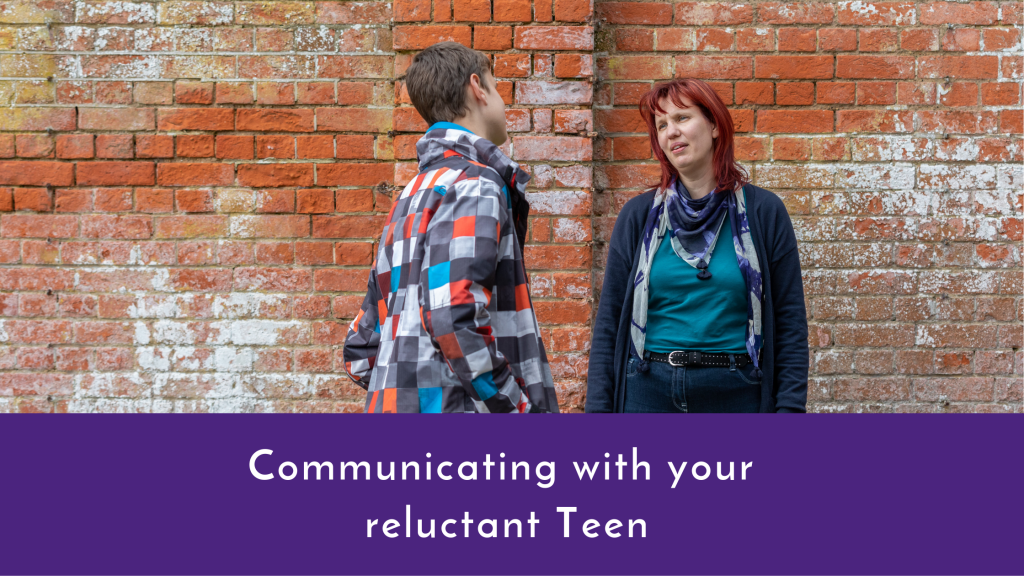
I often write my blogs around the teenage years based on my own experiences, and this one is no exception.
I have two teenage boys, one turning 16 a couple of weeks ago and in the past 3 months I have seen some significant changes in his behaviour, interactions and responses to me and his dad. He does not talk as much, gets irritated by questions and has moments where making the simplest request will result in a sharp response.
In the past I would have seen this change in behaviour as something significant to worry about, and would readily look for a ‘problem’ that he was having.
But the experience I have had working with teens throughout the pandemic, and the understanding of the teenage brain and how it changes and develops throughout the teen years has helped me masses.
And I want to help you too.
Because I know that I am not the only one who struggles with this inconsistent communication, and where grunts and ‘yes’, ‘no’ responses become the norm.
As parents we work on a ‘need to know’ basis, and not knowing can be hard, and lead to our imagination running wild.
If we experience anxiety ourselves (as I do) it can sometimes lead to our thoughts running away with us, and catastrophising situations which are often just a normal stage of teenage development.
So, how do we understand these changes and use this learning to communicate with a reluctant teen?
Our needs versus theirs.
Firstly, and something I often neglect to appreciate, is how much our teens go through in one day. If they are at school, experiencing multiple lessons, multiple interactions with others and many expectations from other adults in their world, it can often be the case that by the time they get home, they are simply exhausted.
I have learnt to understand that teenagers often withdraw, not because they don’t want to speak to us, but because they just need time to process, to allow their brain to make sense of the day they have had and time to just ‘chill’.
If they walk through the door and we want to know how their day was, whether they have remembered to do x,y, z and we expect a response, we are often disappointed.
I have had to really spend time understanding this and hold myself back from wanting to know, all the time. To know helps me as a parent to understand, evaluate and know how I can support him further, but this questioning might suit me, but will not necessarily suit him.
It’s interesting to note that when I do give him some space, and time to himself (without checking up on him to see what he is doing) and am just ‘around’, I often find that he will update me voluntarily, often taking me by surprise.
Being a parent of a teenager has taught me the need to be patient, to not always assume the worst when he is quiet and sometimes withdrawn and to know they know we are there if and when he needs us.
Helping them by not needing to know.
Another thing to note, especially in the later teen years is that they won’t always come to us. This is because our teenagers are learning how to problem solve, to deal with things and move through them without our support. I know that this can sometimes be hard to hear, but this is what we want for our teens, the ability to develop their problem-solving skills, making mistakes and learning from them, and knowing when to ask for help.
I get it, we would be more content parents if our children never had a day of unhappiness or upset, but that is not the real world sadly, and if we try and make everything okay and try and help them navigate away from life’s challenges, in the long run life will end up being more difficult for them. This is because, during the teen years, the neural pathways in the brain are pruning and reconnecting as the brain matures towards adulthood, so the learning and experiences they have during this period will stand them in good stead for the future.
So, lets reframe the challenge for us parents, a teen who is reluctant to communicate. Know that they sometimes need space to process, that they can be more overloaded than they often realise and won’t always know what they need to sort this out. You can offer help but don’t try and solve this for them just because they are not telling you things. Very often, if you create a space which doesn’t feel pressured, think driving them in the car, walking or even sitting at the dinner table, you will find they will share what they need to.
They need to know you are there.
I also want you to know that if they aren’t talking to you, it does not mean you have lost your connection with them either. Teens will naturally not share things with their parents, sometimes it is conscious, sometimes unconscious. Trust your gut feeling with this. The time to pay more attention is when they do not seem to be engaging in everyday life, seem to be losing interest in things they previously enjoyed, or are experiencing a lack of motivation. But still, pick your moment. We had a conversation we wanted to have with our son and my husband used half time at a football match to address it, when he was having a good time, was relaxed and did not feel under pressure or that he was being interrogated.
You know your child, it’s just that the teenage brain development and life experiences they are involved in right now can often cloud their personality and who you know they are. Please know that part of them is still there, it will come back, it’s just we have to hang on in there as parents and trust that not knowing is not necessarily because there is something we need to know.
Trust your teen, and they will learn to trust themselves.
If you or your teen are struggling, I offer a phone call which you can book here (Support for Teenagers | Clare Cogan) for you to decide whether you or your child may benefit from some help and support.